
Professor S. and the Vilnius Basilisk
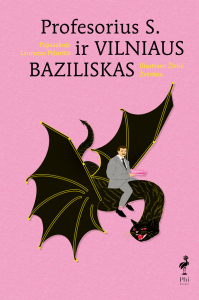
Laurynas Peluritis, Živilė Žvėrūna. Profesorius S. ir Vilniaus Baziliskas (Professor S. and the Vilnius Basilisk), Phi knygos, 2025. – 64 p.
This is the first book in the Mažieji Platonai (Little Platos) series, which tells the story of Vosylius Sezemanas (1884–1963), a well-known Lithuanian philosopher who lived and worked in Lithuania. Sezemanas was a representative of neo-Kantian philosophy, a lecturer, translator of Aristotle’s Poetics into Lithuanian, and a developer of Lithuanian philosophical terminology. Born in Vyborg to a Russified German family, he studied in Saint Petersburg, Marburg, and Berlin. After completing his studies, he chose an academic career and became a professor. From 1923 to 1940, he taught at Vytautas Magnus University in Kaunas.
The book’s plot focuses on the period of Sezemanas’ life when, in the autumn of 1939, he moved with his family to Vilnius, the restored capital of Lithuania. In this historic city, which had experienced nearly two decades under Polish annexation, the professor encountered uncertainty and shadows – political changes, Soviet occupation, the outbreak of World War II in Europe, and later Soviet and Nazi repressions. The author conceptually combines biographical and fictional narrative, while the psychological states of people at the time and the historical context are vividly conveyed through the illustrations of the young artist Živilė Žvėrūna. The protagonist’s interlocutor and companion is a mythological creature emerging from the shadows of Vilnius Old Town – the Basilisk. The author uses this creature as a metaphor for fear, anxiety and uncertainty. At the beginning of the story, the Basilisk is hungry, constantly bares its teeth, and tries to frighten the professor. Yet the philosopher neither fears the creature nor rejects it; he tames it, feeds it, and begins discussing with it the relationship between good and beauty, and the nature of good and evil. The kind-hearted lecturer in aesthetics, history of philosophy, phenomenology, and logic patiently explains to both students and the Basilisk the ideas of ancient philosophers, showing that goodness manifests through virtues of the soul – justice, courage, wisdom and moderation.
Readers learn that Sezemanas was not only a theoretician but also a person who lived by these principles – he exercised, maintained discipline, raised students’ spirits during the occupations, and sheltered a Jewish student in his home. After the war, when Lithuania fell under Soviet rule, the scholar’s truth conflicted with that of the occupiers, and he was exiled to Siberia. The story’s ending is symbolic: upon returning to Vilnius after exile, the professor reunites with his long-missed Basilisk. Rather than dwelling on resentment, he invites his friend to enjoy the sunset. This imagery parallels the sunset of the philosopher’s own life, reminding young readers that “the hope of beauty as a value remains with us even in the darkest times; it cannot be destroyed by the cruellest forces, for beauty is above their power”.
Laurynas Peluritis (b. 1990) is a philosopher, Doctor of Humanities, lecturer at Vilnius University, researcher at the Institute of Philosophy of Vilnius University, and a member of the Lithuanian Philosophical Society. His research focuses on the history of Lithuanian philosophy, the history of ideas and concepts, and political philosophy. Peluritis participates in academic conferences and publishes scholarly works. The biographical fairy tale Professor S. and the Vilnius Basilisk is his debut book for children and young adults.
Živilė Žvėrūna (b. 1992, real surname Spūdytė) is a graphic artist and illustrator with a master’s degree in graphic arts from Šiauliai University. She is considered one of the most original young artists in Lithuania. She works at the Šiauliai Art Gallery and organises creative workshops for children. Žvėrūna is interested in mythology and fairy tales, approaches myths from a contemporary perspective, and seeks to deconstruct them. She primarily works digitally, blending colours on the computer. Her portfolio includes graphic works, animated video clips, and solo exhibitions. The artist aims to provoke and surprise audiences with her work.
Contact for rights: sokratas@phiknygos.lt